How to flatten a slanted, radiused part?

I have a bench I'm working on and the back and the cushion substrate are not only radiused, but slant "inward" towards the bottom of each piece (kinda like a cone). How do you flatten these parts so that they can be machined on a cnc router? And no, I DO NOT own the mechanical version of Bricscad (only the version that came with MicroVellum). Thanks, in advance, for any and all help. I'm attaching the dwg file (in case someone needs to see what I'm trying to do).
Comments
-
If it’s a conical cylinder, you should be able to ask AI to generate a lisp function for you, I think the inside radius, outside radius, and the height should be enough. if your routing the edge angles as well, i.e. like on the top plates? If so, you already have the edge angle. your custom department should be able to use a router table or similar
0 -
Yeah, the shop guys can handle the top plate. It's the other two parts that I'm trying to figure out. I've never done a "lisp". I guess I'll be spending this morning figuring out what those are and how to use them. Thanks for the input.
0 -
Hello.
Alternatively to lisp, still using the method suggested by Its_Alive, you could create a 2D parametric pattern.
The flat pattern should consist of a central part that comes from a truncated semi-cone, and two rectangular sides that are adjacent to the central part.The central part can be calculated using a methodology as the one shown in the article linked below.
0 -
This sort of pattern development existed long before computers existed. Any drafting text book would have a chapter on this sort of stuff.
And while making a few clicks to get a pattern created, is nice, learning to use the automatic software has a learning curve itself. And if you only do something like this very rarely, it may not be worth it.
0 -
Trying to remember my old Tech drafting of cones. This is as far as I got.
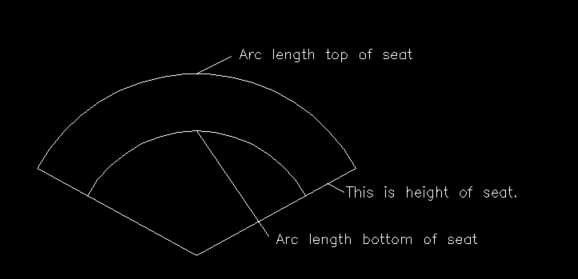
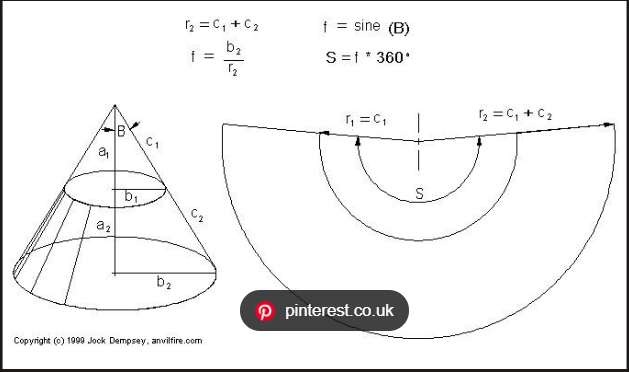 2
2 -
If you don't want to write code, then this could be done using a parametric model. Attach an example with the 3D solid + 2D flattened form driven by the same parameters. Use the parameters manager panel to manipulate.
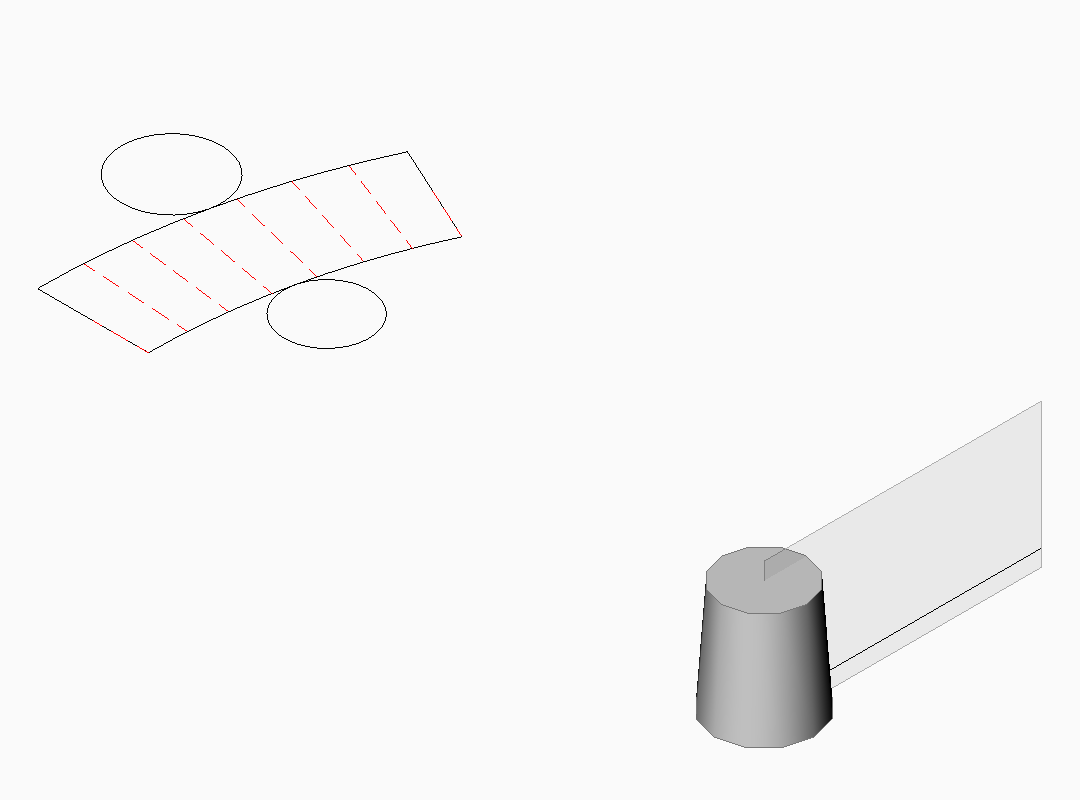
This is the flattened truncated cone by itself.
Jason Bourhill
CAD Concepts Ltd
1 -
I ended up just doing the math and figuring it out that way. It didn't account for the reveals between each panel, but it got me close enough to where the shop guys could manipulate what was machined to their liking. Once I have some free time, I'm going to look into Jason's suggestion.
0 -
A lisp I wrote 26 years ago. It may help you.
0


