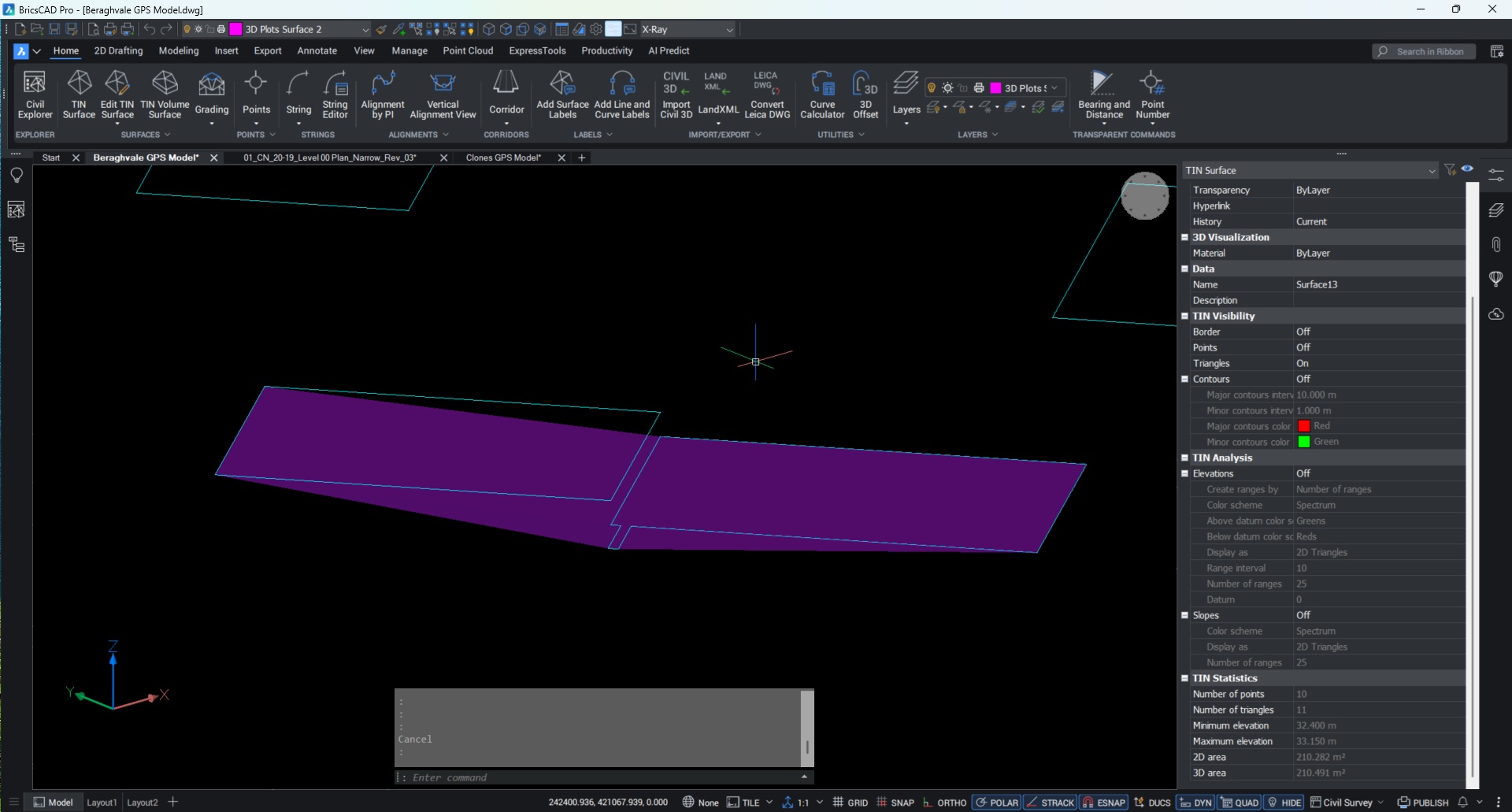
Tin Surface not stepping on Z axis SOLVED

I'm working on a model of a building site with 120 houses, trying to make up surfaces of each plot to create a reduced dig surface for the excavators.
Each plot is broken down into the dwelling, driveway, grass area and concrete, each of which needs different reduced dig levels for the required fill to end up at the correct levels.
I have all my boundaries created of each part and all are closed, but when I try to tin the surface it seems to ignore Z values on over lapping lines (Attached a picture so you can see what I mean).
I've tried adding breaklines, points, creating the TIN from points, breaklines and every combnataion I can think of really, but cant get it to create 2 seperate 'platforms' while still being the TIN one surface, but it always seems to not count in 2 points on the top platform.
Any ideas which setting I havent turned on or have set incorrectly?
Comments
-
Hello.
There should be no overlapping points when creating a TIN surface.
In a standard TIN surface, a 90-degree vertical drop is not possible.
A TIN surfaces requires unique X-Y coordinates for every vertex and cannot stack two points with the same X-Y and different Z values.A solution is to slightly move one of the overlapping edges, so that there are no overlapping points when creating the TIN.
0 -
Agree with Virgil "a 90-degree vertical drop is not possible." if you just have even a 1mm difference then your TIN's should start to work.
When using grading tools to make the pads you often have to have an almost vertical batter slope between two pad areas.
Have a look at Civil Site Design has smart grading tools, runs inside Bricscad, even each edge can have a different batter. There are Youtube videos should be one of a house slab.
0 -
Ahh that sucks… for me, but atleast I know for the future..
What I ended up doin was offset each area by 1mm onto a new layer and then deleted the old layer. wasn't a huge ordeal but I'll know to add that into the process in the future.
0 -
Just a comment, our surveyors when doing field survey would do retaining walls top and bottom and make sure they offset the verticals just slightly so when a TIN was made did not have problems.
0